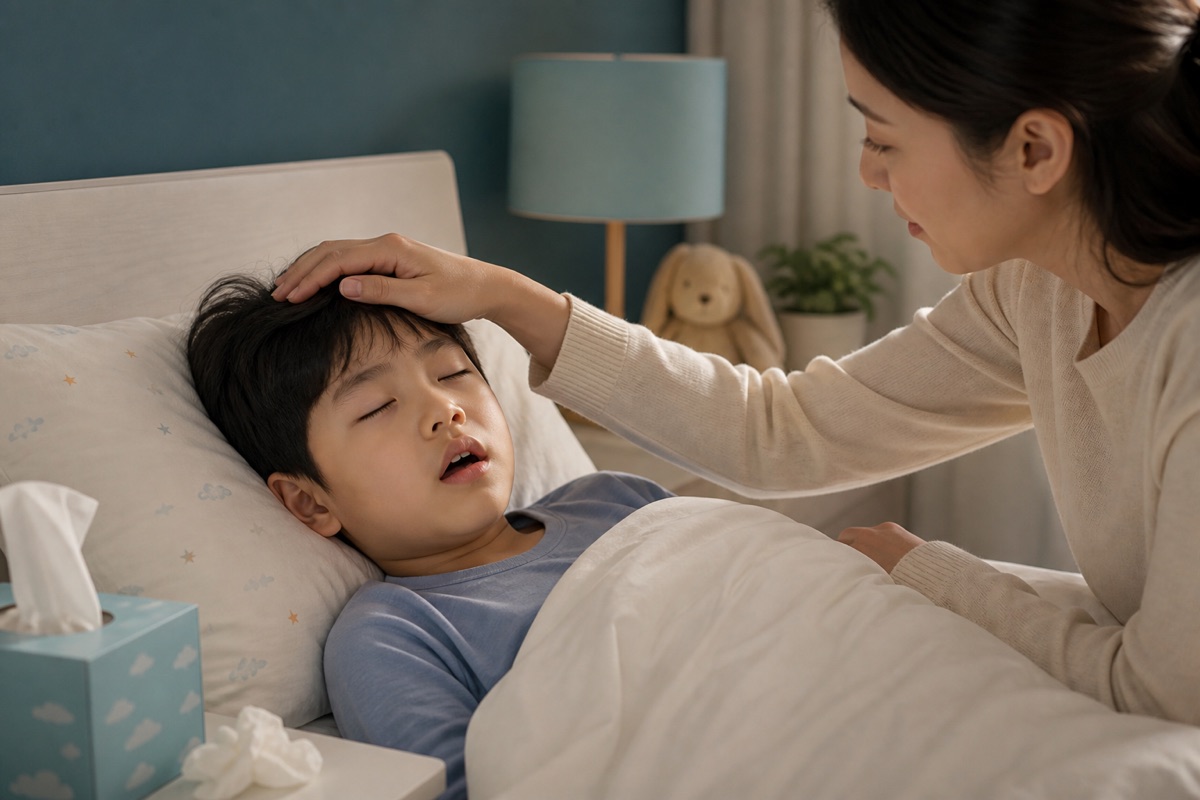
Treating childhood rhinitis as simply a smaller version of adult rhinitis can miss important differences. Your child may not be able to verbally explain a stuffy nose, but instead signals it by sleeping with their mouth open, rubbing their nose repeatedly, or becoming restless during the day. In addition, children have a separate variable called adenoids, so even the same nasal congestion may have different causal structures.
Below, we explain the points at which pediatric rhinitis differs from that of adults, observational findings actually confirmed in the clinic, parents’ common concerns about medications, and the level of evidence for environmental management.
Summary
- In children, nasal congestion often first manifests itself as mouth breathing and poor sleep quality.
- If adenoid enlargement is accompanied, nasal congestion cannot be resolved with medication alone.
- Observations such as nose rubbing habit (allergic salute) and under-eye shadows are clues.
- If sinusitis or otitis media recurs, it is necessary to check whether there is rhinitis in the background.
- Concerns about growth with nasal steroids vary depending on dose, duration, and formulation, and medical consultation is preferred over arbitrary discontinuation.
1. How pediatric rhinitis differs from adults
1-1. Mouth breathing and sleep
The inside of a child’s nose is narrower than that of an adult, so even with the same degree of mucous membrane edema, airflow is reduced to a greater extent. As a result, you spend more time breathing through your mouth instead of your nose, and you may also experience snoring, tossing and turning, and frequent changes in posture while sleeping. If your breathing is unstable during sleep, you may not feel refreshed in the morning even if your total sleep time seems sufficient.
If mouth breathing continues for a long time, the mouth dries out and the pharynx is directly exposed to cold air, causing frequent throat symptoms. The strength of the conclusions regarding the association with facial bone growth varies between studies.
1-2. Attention and Learning
Children who do not sleep well at night may appear more distracted during the day rather than sleepy. If complaints about difficulty concentrating in class and chronic nasal congestion coincide at the same time, it is a reason to check the nose and sleep before approaching it solely as a behavioral problem.
1-3. Adenoid hypertrophy
Adenoids are lymphoid tissue located at the back of the nose that grow larger during infancy and gradually shrink after school age. If this tissue is enlarged, nasal congestion and snoring remain even after treatment for allergic rhinitis. This is why it is confirmed with endoscopy or radiography.
2. Findings commonly observed in the clinic
| Finding | What it looks like | Implications |
|---|---|---|
| Allergic salute | Repeat the movement of pushing the tip of your nose upward with your palm | Chronic itchiness, runny nose, and horizontal wrinkles on the bridge of the nose |
| Shadow under the eyes (dark circles) | Dark pigmentation in the lower eyelid area | Associated with venous congestion and common in those predisposed to allergies |
| Open mouth expression, dry lips | Breathing through the mouth during the day | Possibility of persistent nasal congestion |
| Frequent coughing/clearing throat | Postnasal drip irritation | Avoid interpreting a cough as just a cold |
| Recurrent nosebleeds | Anterior nasal mucosa irritation | Often overlaps with rubbing habits and drying |
These findings do not confirm the diagnosis, but serve as a starting point for asking “when and how often.”
3. Connection with repeated sinusitis and otitis media
In children, the canal connecting the ear and nose is shorter and more horizontal than in adults. If inflammation and secretions remain at the back of the nose for a long time, middle ear ventilation may deteriorate, and otitis media with effusion may repeat or persist for a long time. Sinusitis may also be caused by uncontrolled rhinitis or adenoid problems in the background.
So, if the same situation recurs even after using antibiotics multiple times, an approach is needed to check for a common background rather than looking at each infection separately.

4. Common concerns about drugs
4-1. Antihistamines
First-generation antihistamines are used with caution in school-age children because drowsiness and difficulty concentrating are relatively noticeable. This effect is less common in the second generation, but since there are individual differences, it is actually helpful for parents to observe and inform their child’s reaction after taking the drug. Since the approved ingredients and dosages are determined by age, adult medication should not be split or given without professional guidance.
4-2. Nasal steroids
Because of the word “steroid,” some families do not use a prescribed treatment. Nasal sprays act locally on the nasal mucosa, and their absorption route and exposure dose are different from systemic steroids. Concerns about growth have been examined in long-term use studies, with results varying depending on the ingredients, dose, and duration of use.
What is actually important is to stick to the prescribed dosage, aim the spray outward rather than towards the nasal septum, and once symptoms are controlled, discuss when and how to reduce the dose with your doctor. I do not recommend using it for a long time arbitrarily or conversely, using it for a few days and then discontinuing it. Regularly recording a child’s height growth can be used as a reference for making decisions.
5. Environmental management, how much evidence is there?
- Dust mite: Several reviews have shown that there is no clear evidence for symptom improvement through single measures (just putting on a cover or changing a vacuum cleaner). The benefit is more likely to be meaningful when hot-water bedding washes, humidity control, and cleaning of carpets and stuffed toys are combined.
- Pet: If a child is confirmed to be sensitized, the principle is to reduce exposure, but in reality, separation is often difficult. At a minimum, restricting bedroom access and bedding management are priorities.
- Ventilation: Recommended for indoor air quality management. However, prolonged ventilation during the morning hours during pollen season can actually increase exposure, so it is better to adjust the timing.
- Humidity: The 40-50% range is acceptable. If you raise it too high, mites and mold will increase.
Environmental management is less of a replacement for medicine and more of a background measure that reduces the amount of work the medicine has to do.
6. When to see an ENT specialist
- When nasal congestion lasts for more than 4 weeks or repeats regardless of the season
- When snoring occurs frequently while sleeping and moments when breathing appears to stop are observed.
- When breathing with your mouth open even during the day becomes a habit.
- When receiving treatment several times a year for otitis media or sinusitis
- When smelly mucus comes from only one nostril (including possible foreign bodies)
- When there is no change in symptoms despite regular use of medication
In particular, the second item may be linked to breathing problems during sleep, so it is better not to just observe it.
Frequently Asked Questions
Q. Does rhinitis in children get better on its own as they grow older? A. In some cases, it eases as you grow, and in other cases, it changes form into asthma or other allergic diseases. The course varies from child to child, making it difficult to generalize. Rather than waiting for it to get better on its own, it is more practical to judge whether there is any disruption to your sleep and daily life now.
Q. Can I have my child do a nose wash? A. Since saline nasal irrigation is not a drug, it can generally be combined with other care. However, if the child refuses, it is better not to proceed too forcefully, and consult with the doctor in charge to determine the method and container appropriate for the child’s age and level of cooperation. If the child has acute otitis media, ask the treating clinician before performing irrigation.
Q. At what age do you get an allergy test? A. Rather than age, the criterion is whether the test results change the direction of treatment. It is meaningful in situations where the causative agent is identified and an environmental management direction is determined or immunotherapy is considered. Otherwise, symptom control is done first. After a clinical evaluation, you can discuss whether testing is likely to help.
This article is general health information and is not a substitute for individual medical care. If symptoms persist or worsen, please seek treatment at a medical institution.