When it comes to not smelling well, there are two main patterns clinicians consider. One is when the inside of the nose is blocked and odor molecules cannot reach the area where smell is detected, and the other is when the molecules reach but there is a problem with the nerve that receives them. Even though they have the same “decreased sense of smell,” the causes, confirmation methods, and subsequent course are different.
There is another common misconception. Many people come to us with a problem with their sense of taste, saying, “Food has lost its taste,” but in reality, many of them have a decreased sense of smell. Below we have summarized the classification of decreased sense of smell, what clinicians assess, and signs that require prompt treatment.

Summary
- Decreased sense of smell is broadly divided into conductive (blockage) and sensorineural (nerve damage).
- Common causes of conductive loss include nasal polyps, chronic sinusitis, severe septal deviation, and swollen nasal mucosa.
- Representative examples of sensorineural disorders include olfactory impairment after viral infection, head trauma, neurodegenerative diseases, and aging.
- Many complaints of “no taste” are a matter of smell, not taste.
- Sudden loss of sense of smell on one side, accompanied by neurological symptoms, or occurring immediately after trauma requires medical attention without delay.
1. How does the sense of smell work?
When you breathe in, odor molecules enter your nostrils and reach the olfactory epithelium near the roof of the nasal cavity. Olfactory neurons distributed here generate signals that pass through the base of the skull to the olfactory bulb, and these signals are interpreted as “smell” in the brain. In other words, for the sense of smell to be established, the passage through which molecules reach, the epithelium and nerves that sense them, and the centers that interpret them must all be normal.
Which of these paths is broken becomes the standard for classification.
2. Conductive olfactory loss — when odor molecules cannot reach the sensory area
If the airflow to the upper nasal cavity is physically blocked, you will not be able to smell even if your nerves are intact.
- Nasal polyps: Soft-tissue growths caused by chronic inflammation can block airflow to the olfactory area. In many cases, decreased sense of smell appears as an early symptom.
- Chronic sinusitis: Mucosal swelling and secretions narrow the passage, and the inflammation itself affects the olfactory epithelium.
- Septal deviation, inferior turbinate hypertrophy: Structurally, upward airflow is reduced.
- Acute exacerbation of allergic rhinitis: The sense of smell may decline temporarily while the lining is swollen and recover as the swelling subsides.
Conductive loss often fluctuates such as “it gets worse when nasal congestion is severe, and gets better when the nose is open.” This variation itself is a useful clue for differentiation.
3. Sensorineural olfactory loss — when the sensory pathway is impaired
| Cause | Characteristic course |
|---|---|
| Smell impairment after infection (viruses such as colds and coronaviruses) | Even after the acute phase has passed, only the sense of smell remains. Often changes slowly |
| Head trauma | Occurs immediately after the accident. There is a significant difference depending on the degree of damage to the olfactory nerve fibers. |
| Neurodegenerative diseases (Parkinson’s disease, Alzheimer’s disease, etc.) | Progress slowly. May appear before motor and cognitive symptoms |
| Aging | Slow deterioration over many years. usually both sides |
| Exposure to medications or toxic substances | Relates to timing of use of certain medications or exposure to chemicals |
| Tumors (rare) | Only one side, proceed slowly. May be accompanied by other neurological symptoms |
Anosmia after infection is one of the common causes. After the upper respiratory infection has passed, the stuffy nose and runny nose have cleared up, but the smell has not returned. It may change over time, and the degree of recovery varies greatly from person to person. Parasmia, where smells are distorted (familiar smells become unpleasant, etc.), may appear during the recovery process.
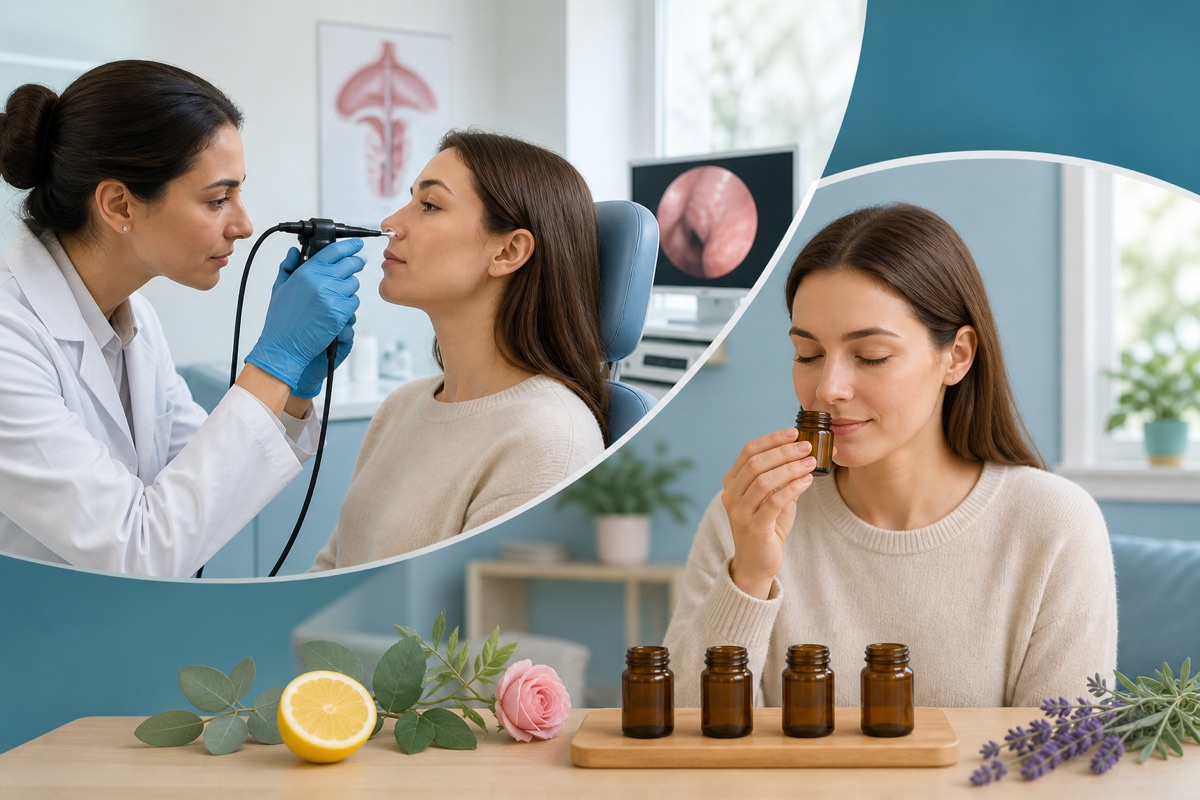
Something often mentioned during this period is **olfactory training**. It is a method of consciously smelling several distinct scents (e.g., rose, lemon, eucalyptus, cloves) twice a day for 20 to 30 seconds each and recalling the smell. It is assumed to be continued for several months. Although it is a low-risk approach that can be practiced at home, it does not give the same results to everyone and is not a substitute for assessing the cause. We recommend that you check the cause at least once before starting.
4. Why “no taste” is actually an olfactory problem
The taste senses that the tongue senses are sweet, salty, sour, bitter, and savory. Most of the flavor we commonly call ‘taste’ is created when aroma molecules from food ascend to the nose through the back of the throat (retronasal olfaction). So, when your sense of smell is lost, you get the feeling that “it’s bland, I don’t know what the food is” even though the sweet or salty taste remains.
In fact, it is rare for the sense of taste alone to fail. This is why we first check the sense of smell for those who come to us due to a change in taste.
5. What clinicians assess
| Step | What is assessed |
|---|---|
| Medical history | Time and pattern of onset (sudden/slow), preceding infection or trauma, unilateral or bilateral, presence of nasal congestion, medications taken, occupational exposure |
| Nasal endoscope | Check for nasal polyps, mucous membrane edema, discharge, nasal septum condition, and passages around the olfactory area. |
| Smell test | Quantitative evaluation of odor recognition and identification abilities. It is useful for establishing a baseline as subjective complaints and actual degrees may differ in some cases. |
| Imaging test | If necessary, check inflammation and structure with sinus CT, and check intracranial lesions with MRI if the cause is unclear or there are neurological findings. |
“When and how the loss of smell began” plays a particularly large role in the diagnosis. If possible, it would be helpful to summarize when it started and the circumstances around that time (cold, bump, taking new medication, etc.).
6. When prompt medical attention is needed
- Sudden loss of sense of smell in only one nostril
- If you have neurological symptoms such as headache, changes in vision, facial numbness, double vision, or cognitive changes
- Occurs immediately after head trauma
- When nosebleeds, stuffy nose on one side, and facial pain persist along with decreased sense of smell
- If there is no sign of recovery for several weeks or more after the infection has passed
Because the course varies depending on the cause, it is important to first distinguish whether it is a situation in which to wait for natural recovery, a situation in which inflammation or structural problems need to be resolved, or a situation in which other tests are needed. In particular, if conductive factors are also present, there is room for adjustment after confirmation, so it is better to be evaluated early rather than waiting for a long time.
Frequently Asked Questions
Q. My sense of smell does not return after a cold. How long should I wait? A. If your sense of smell continues to decline even after the acute symptoms have resolved, it is best to get checked within a few weeks. This is because it is necessary to distinguish whether there are modifiable factors, such as remaining inflammation or edema in the nose, or whether it should be considered sensorineural. The degree and speed of recovery varies greatly from person to person, so it is difficult to say unequivocally.
Q. Can I do smell training alone? A. The method itself is not difficult and there is little burden, so you can try it on your own. However, if the cause is a passage problem such as nasal polyps or sinus inflammation, training alone may not be the right approach. Before starting, please get an evaluation of the cause and see which method is right for your situation.
Q. Do you lose your sense of smell as you get older? A. It is a known change that our sense of smell gradually declines as we age. However, aging changes usually progress slowly over several years on both sides. If it has clearly worsened in a relatively short period of time or is only a problem on one side, you need to get it checked out rather than just blaming it on your age.
This article is general health information and is not a substitute for individual medical care. If symptoms persist or worsen, please seek treatment at a medical institution.