“My child doesn’t have a cold, but always sounds stuffed up, and at night snores with the mouth open.” This is something we often hear from parents in pediatric visits. In these cases, we check whether the adenoids at the back of the nose are enlarged.
The adenoids are tissue that naturally grows larger in early childhood and then shrinks as a child grows, so enlargement alone does not always need treatment. This article covers the problems enlarged adenoids can cause, and when to watch and wait versus when to consider surgery. The effects of the mouth-breathing habit are covered in a separate article.

Summary
- The adenoids are lymphoid tissue on the roof of the throat behind the nose; they grow larger in early childhood and shrink as a child grows
- When enlarged, they can cause nasal congestion, open-mouth breathing, snoring, a nasal-sounding voice, and recurrent middle ear infections
- Their size is checked with an endoscope or an X-ray and assessed together with how severe the symptoms are
- When symptoms are mild, rhinitis treatment and watchful waiting are often the approach
- Breathing problems during sleep, recurrent or persistent middle ear infections, and nasal congestion that interferes with daily life are criteria for considering surgery
1. What are the adenoids?
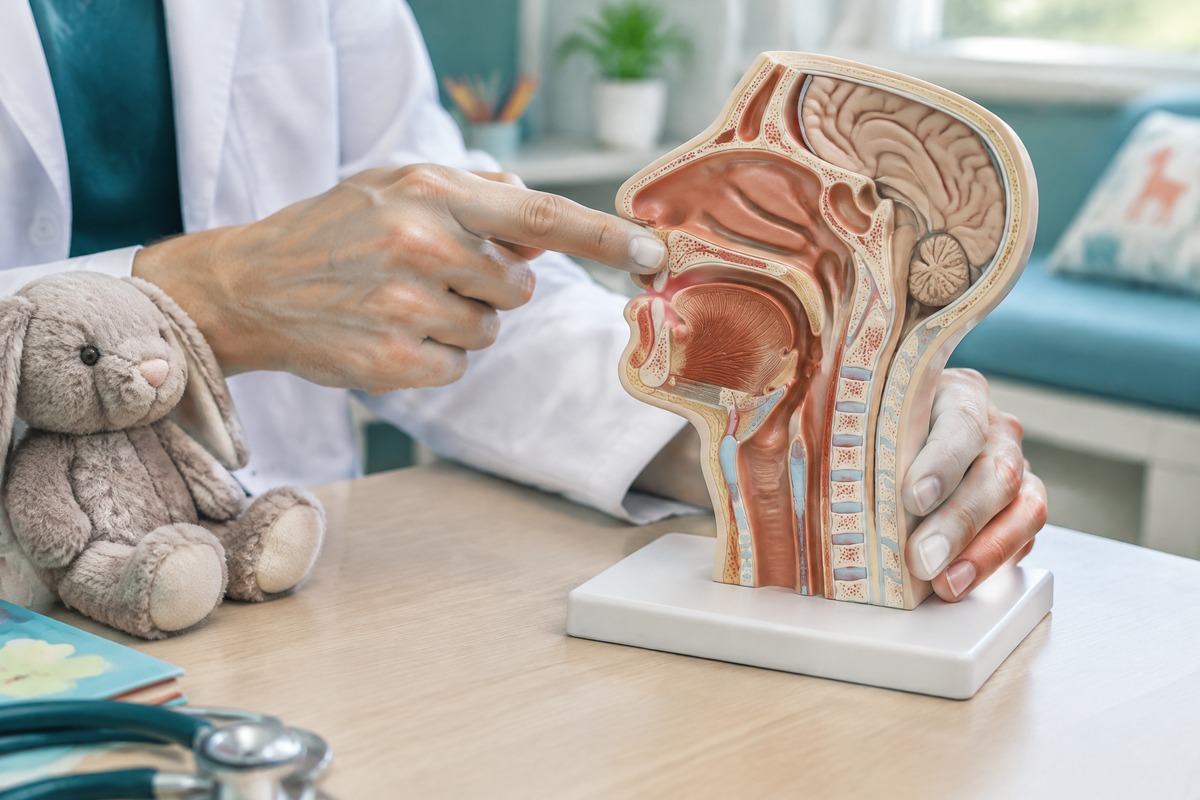
The adenoids are lymphoid tissue attached to the roof of the throat behind the nose, above the uvula. Because they sit where they cannot be seen even with the mouth open, they are different from what people commonly think of as the tonsils. They are among the first tissues to encounter bacteria and viruses entering through the nose and mouth, and they play a role in the immune response.
The adenoids generally begin to enlarge in infancy, reach their largest size around the preschool years, and then gradually shrink, becoming considerably smaller by adolescence. During this period, frequent colds or allergic rhinitis can make them even larger. As a result, the same child’s symptoms may look different right after a cold compared with a period when the child is feeling well.
2. Symptoms of enlarged adenoids
When the adenoids are enlarged, the passage from the nose to the throat becomes narrower. This can lead to the following symptoms.
- Persistent nasal congestion even without a cold, and breathing with the mouth open
- Snoring during sleep, or gasping for breath or briefly pausing breathing
- A voice that sounds blocked up, and a tendency for a runny nose to last a long time
- A feeling of fullness in the ears, or recurrent middle ear infections
- Morning tiredness from not sleeping deeply, and irritability or poor concentration during the day
The adenoids sit near the opening of the Eustachian tube, which connects the ear and the nose, so when they are enlarged they can interfere with ventilation of the tube or become a place where bacteria linger. As a result, otitis media with effusion, in which fluid builds up behind the eardrum, can develop easily and last a long time. If your child turns the TV volume up loud or often doesn’t respond when called, a hearing check is needed.
These symptoms often overlap with those of colds or allergic rhinitis, which makes them hard for parents to tell apart. A cold usually improves within 1–2 weeks, whereas congestion from enlarged adenoids continues in much the same way for months even after the cold has passed; this is a useful clue.
3. How are they checked?
In the clinic, we first ask about what parents have observed during the child’s sleep and how long the symptoms have lasted. A short video recording of the child’s breathing while asleep is a great help in making an assessment.
| Test | What it checks |
|---|---|
| Nasal endoscopy | Direct observation of how much the adenoids block the passage at the back of the nose |
| Lateral X-ray | Indirect assessment of adenoid size and airway space |
| Eardrum examination and hearing test | Whether there is otitis media with effusion or hearing loss |
| Polysomnography (sleep study) | Assessment of severity when sleep apnea is suspected |
Even with adenoids of the same size, the severity of symptoms differs from child to child. For this reason, treatment is not decided on test results alone; symptoms, the impact on daily life, and whether there are accompanying ear problems are considered together.
4. When to watch and wait, and criteria for considering surgery
If symptoms are mild and there are no problems with sleep or the ears, watchful waiting is often the approach. If allergic rhinitis is also present, rhinitis treatment such as a nasal steroid spray may reduce congestion, and saline rinses and managing the indoor environment can also help.
While watching and waiting, there are a few things parents can usefully keep an eye on. Check whether congestion and open-mouth breathing continue even after a cold has passed, whether snoring appears only during colds or continues almost every night, and whether the child has trouble getting up in the morning or seems unusually distracted during the day. If there has been a middle ear infection, it is important to recheck the eardrum and hearing at the scheduled time to see whether the fluid has cleared. Recording these changes every few months provides objective evidence when deciding whether surgery is needed. If symptoms clearly decrease as the child grows, continued watchful waiting is often the approach.
An adenoidectomy is discussed in the following situations. If the tonsils are also enlarged, a tonsillectomy may be performed at the same time.
- Sleep-disordered breathing has been confirmed, such as pauses in breathing or gasping during sleep
- Otitis media with effusion persists for a long time or keeps coming back, raising concerns about hearing or language development
- Nasal congestion and open-mouth breathing continue despite medication and interfere with daily life
- Adenoid inflammation or sinusitis keeps recurring despite treatment
The surgery is performed through the mouth under general anesthesia, so it leaves no scar on the face. The recovery period, precautions, and risks such as bleeding, which can occur in rare cases, are discussed thoroughly with the doctor before surgery. If allergic rhinitis is present, some nasal symptoms may remain after surgery, so ongoing rhinitis management is still needed.
5. Signs that your child should see a doctor
- Your child is often seen to stop breathing and then gasp during sleep
- Snoring continues almost every night
- Your child often doesn’t hear when called or says the ears feel blocked
- Your child is excessively sleepy during the day or seems to be growing more slowly than peers
- Foul-smelling discharge keeps coming from only one side of the nose
Frequently Asked Questions
Q. Don’t the adenoids shrink on their own as a child grows? A. They usually shrink with growth. However, if sleep or ear problems continue while waiting for them to shrink, the impact during that period is taken into account when deciding on treatment.
Q. Doesn’t removing the adenoids weaken the immune system? A. The adenoids are only one part of many immune tissues, and there is no clear evidence that immune function drops significantly after removal. The decision about surgery is made by weighing the benefits against the risks.
Q. My child only snores and has no other symptoms. Is testing needed? A. If your child snores only occasionally during colds, watching is fine. If your child snores almost every day or appears to stop breathing, it is a good idea to see a doctor to identify the cause.
Related reading
- Mouth Breathing: How the Habit Affects Children and Adults
- Managing Allergic Rhinitis in Children — What Not to Miss During Growth
- Sleep Apnea Symptoms Self-Check: Signs You Should Get Tested
This article is general health information and is not a substitute for individual medical care. If symptoms persist or worsen, please seek treatment at a medical institution.