Because sleep apnea happens while you are asleep, the person who has it is often unaware of it. Many people come to the clinic only after a family member mentions that “you seem to stop breathing in your sleep,” or after daytime sleepiness and fatigue have built up.
How snoring develops, lifestyle changes to reduce it, and the costs of testing and treatment are covered in separate articles. This article focuses on how to check yourself for symptoms that may point to sleep apnea, and on when you should get tested.

Summary
- Sleep apnea is a condition in which the airway repeatedly narrows or becomes blocked during sleep, so breathing is reduced or stops
- Witnessed pauses in breathing, heavy snoring, daytime sleepiness, and morning headaches are the typical signs
- Obesity, high blood pressure, a thick neck, male sex, and increasing age raise the risk
- It cannot be diagnosed with a questionnaire alone; objective testing such as polysomnography (an overnight sleep study) is needed
- If you feel drowsy while driving, it is best not to put off testing
1. What is sleep apnea?
When you fall asleep, the muscles around the throat relax and the airway narrows. Obstructive sleep apnea is a condition in which this narrowing becomes severe enough that breathing stops for 10 seconds or more, or is markedly reduced, over and over throughout the night. When breathing stops, the oxygen level in the blood drops; the brain senses this and briefly wakes you so that you start breathing again.
When these brief awakenings repeat, you do not get deep sleep, even if you do not remember waking up. As a result, you keep waking up unrefreshed even though you spent enough time in bed. Left untreated over the long term, it is known to be associated with conditions such as high blood pressure, arrhythmia, and diabetes, so it is important to check for it early.
2. Symptom self-check
See how many of the items below apply to you. For nighttime symptoms, asking the family member who sleeps with you will give a more accurate picture.
| Time of day | What to check |
|---|---|
| Night | Loud, irregular snoring; breathing that stops and then restarts with a choking or gasping sound; frequent tossing and turning; waking up several times at night to urinate |
| Morning | Not feeling refreshed after sleep, morning headaches, dry mouth or a sore throat |
| Daytime | Easily dozing off during meetings or reading, drowsiness while driving, reduced concentration and memory, irritability |
If several nighttime and daytime items apply together, the possibility of sleep apnea should be kept in mind. Medical institutions sometimes use questionnaires that assess the degree of daytime sleepiness, or screening questionnaires that ask about snoring, fatigue, witnessed pauses in breathing, high blood pressure, and so on. However, these questionnaires are only tools for identifying who needs testing; they cannot replace a diagnosis.
When family members observe your sleep, there are a few things worth watching for: whether steady snoring is suddenly interrupted by moments of silence, whether that is followed by a choking sound or by tossing and gasping for breath, and whether this happens repeatedly in a single night. It also helps to note whether there is a difference between lying on your back and lying on your side. Recording a few minutes of audio or video of yourself sleeping on a phone makes it much easier to explain at your appointment. If you live alone, you can try using a feature that records sounds during sleep.
In women and older adults, insomnia, fatigue, low mood, and morning headaches are sometimes the main symptoms rather than typical snoring. Because of this, the condition is sometimes overlooked as simple fatigue or menopausal symptoms.
3. Factors that raise the risk
- Being overweight or obese, especially with recent weight gain
- A thick neck, or a small or receding jaw
- Enlarged tonsils, or chronic nasal congestion due to rhinitis or a deviated septum
- Male sex, and rising risk with age; in women, risk increases after menopause
- Drinking alcohol before bed, or taking sleeping pills or sedatives
- High blood pressure, especially high blood pressure that is poorly controlled even with medication
If several risk factors overlap and items from the self-check above also apply, it is a good idea to get tested.
In particular, if snoring that was not there before appears as you gain weight and daytime sleepiness gets worse, it is worth considering that sleep apnea may have newly developed or worsened. Daytime sleepiness is easily mistaken for a matter of willpower or laziness, but it can be caused by breathing problems that repeat throughout the night. Because drowsiness can lead to mistakes at work or danger on the road, it is important not to dismiss it as simple fatigue.
4. What tests are done?
| Test | How it is done | Features |
|---|---|---|
| Polysomnography (an overnight sleep study) | You sleep overnight in a sleep lab while brain waves, breathing, oxygen saturation, leg movements, and more are recorded | The standard test, which evaluates the severity of sleep apnea along with other sleep disorders |
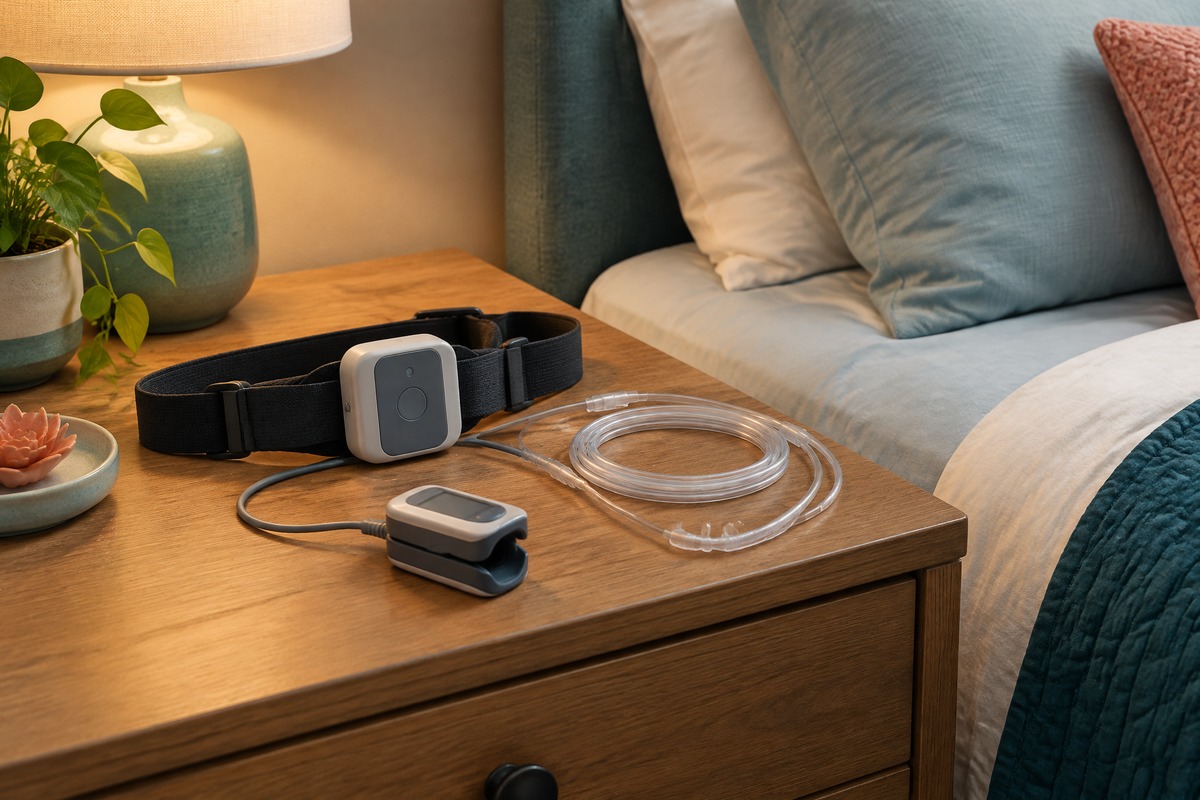
| Home sleep test | You sleep at home wearing a simplified device that focuses on breathing and oxygen saturation | Used selectively in adults with a high level of suspicion and few coexisting conditions |
Severity is assessed based on the number of times per hour that breathing stops or decreases, and the treatment approach is decided by also taking symptoms and coexisting conditions into account. At an ENT clinic, the structures of the nose and throat are also examined with an endoscope to identify where the airway narrows. On the day before the test, it is best to go about your day as usual and avoid alcohol.
Many people worry about whether they will be able to fall asleep in an unfamiliar sleep lab, but even if sleep is a little lighter than usual, enough data to make an assessment can usually be obtained. Let the team know in advance about any medications you take regularly, and do not stop them on your own. Because the results show not only breathing during sleep but also sleep structure and changes in oxygen levels, they serve as the basis for discussing treatment options afterward.
5. Signs that you should see a doctor
If any of the following apply, it is best not to put off testing.
- You become drowsy while driving, or have nearly had an accident because of drowsiness
- A family member has repeatedly seen you stop breathing during sleep
- Your blood pressure is poorly controlled even with medication, or you have been diagnosed with an arrhythmia
- You repeatedly wake up startled, feeling as if you are choking or cannot breathe
- A child snores and stops breathing during sleep, or is excessively restless and sleepy during the day
Frequently Asked Questions
Q. If I don’t snore, does that mean I don’t have sleep apnea? A. Most cases involve snoring, but in some cases the snoring is not loud or family members do not notice it. If daytime sleepiness and morning headaches persist, it may be worth getting checked even without snoring.
Q. Can sleep apnea be diagnosed from the oxygen saturation or sleep data on a smartwatch? A. It can be used as reference information for looking at your daily habits, but it is not a diagnostic tool. If abnormalities keep showing up in the data, it is a good idea to take that as a prompt to get tested at a medical institution.
Q. Can sleep apnea occur even in people with a slim build? A. Yes, it can. Inborn structural features such as a small jaw or enlarged tonsils, as well as nasal congestion, can also be causes, so body type alone is not used to judge it.
Related reading
- Snoring Causes and Lifestyle Fixes: Start With Sleep Position, Weight, and Alcohol
- Snoring and Sleep Apnea Testing and Surgery Costs — What Korean Private Insurance Covers
- Mouth Breathing: How the Habit Affects Children and Adults
This article is general health information and is not a substitute for individual medical care. If symptoms persist or worsen, please seek treatment at a medical institution.