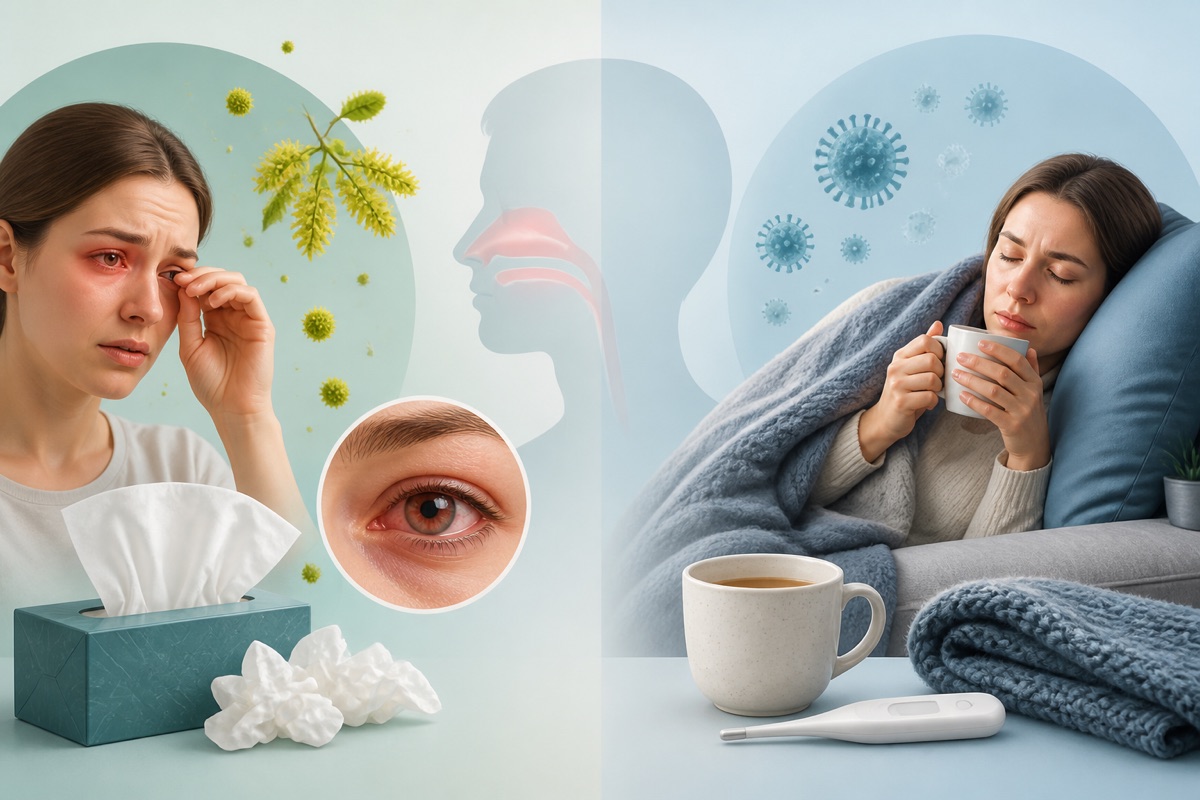
Three questions help distinguish allergic rhinitis from a cold: Have symptoms lasted longer than 10 days? Are fever, sore throat, or body aches present? Are the eyes itchy? Colds usually get better within 7 to 10 days and are accompanied by systemic symptoms, and the eyes remain fine. Allergic rhinitis lasts for several weeks or longer and is often accompanied by no fever and itchy eyes.
There is a third condition to be identified here. It is an acute sinusitis that starts as a cold and then progresses, but the management direction is different from the previous two and needs to be differentiated.

Summary
- More than 10 days + No fever + Itchy eyes → Allergic rhinitis
- Within 7 to 10 days + Sore throat and body aches preceding + Change in color of runny nose → Cold
- More than 10 days + yellowish runny nose + facial pain, or improves and then worsens → suspected sinusitis
- The two may overlap. People with rhinitis have more severe and prolonged colds.
1. The two conditions have different causes
A cold is an upper respiratory infection caused by rhinoviruses or other respiratory viruses. Once the virus is eliminated, the symptoms end, so there is a natural course.
Allergic rhinitis is not an infection but an IgE-mediated hypersensitivity reaction to a specific antigen. Symptoms last as long as you are exposed to the causative agent and stop when the exposure goes away. This is why the concept of “getting better” applies differently to a cold.
The reason this difference is important in practice is because the response is different. For colds, time and symptom relief are key, but allergic rhinitis remains the same even after several months if the cause is not avoided and anti-inflammatory management is not done.
2. Symptom-by-symptom comparison
| Item | Allergic rhinitis | Cold |
|---|---|---|
| Onset pattern | Suddenly, immediately after exposure | Gradually over 1 to 3 days |
| Duration | Weeks to months, repeated annually | 7-10 Days |
| Runny nose | Clear and watery, lasts until the end | Clear at first → Gradually becoming thicker and changing color |
| Sneeze | Continuous paroxysmal | Sporadic |
| Eye symptoms | Itching, redness, and tears are common. | Usually none |
| Fever | None | There may be |
| Sore throat | Rare (even if present, itches) | Common and often an early symptom |
| Muscle pain and chills | None | Common |
| Trigger | Dust, pollen, pets, cold air | Contact infection |
| Transmission to people nearby | None | Similar symptoms in family and workplace |
Particularly reliable indicators
In practice, the most useful clues are itchy eyes and the presence or absence of fever. Symptoms of itchy and rubbing eyes are accompanied by allergic conjunctivitis and are not common in viral colds. Conversely, if you have a fever accompanied by chills, allergic rhinitis alone is not the explanation.
Nasal mucus color is a commonly used but unreliable indicator. Yellowish runny nose does not necessarily mean a bacterial infection, and the color changes as white blood cells gather during the course of a viral cold.
3. Self-checklist
Clues favoring allergic rhinitis
Clues favoring a cold
If you have 4 or more rhinitis + 1 or less cold, you likely have allergic rhinitis. However, this checklist is for guidance only and is not a substitute for diagnosis.
4. A third possibility — acute sinusitis
If any of the following occur during the course of a cold, it may have progressed to sinusitis: These are the items mentioned in clinical practice guidelines as criteria for suspecting bacterial acute sinusitis.
- Symptoms persist for more than 10 days without improvement
- Pressure and pain in the cheek or forehead area, which worsens when the head is lowered
- Fever above 39 degrees and purulent runny nose for more than 3 to 4 days
- Double aggravation — Symptoms that got better got worse again after 5 to 6 days.
- Decreased sense of smell
Among these, double worsening is a particularly characteristic finding, so it is helpful to remember the progress yourself during treatment.
5. When the two conditions overlap
When a person with allergic rhinitis catches a cold, the symptoms are more severe and last longer. As infection is added to the already inflamed mucous membrane, edema increases and the sinus drainage passages become blocked, increasing the risk of sinusitis.
Many of the expressions such as “I have a cold that hasn’t gotten better for two months” are actually allergic rhinitis left over from a cold, or a condition that has progressed from a cold to sinusitis. If the period is outside the normal range, we must first look at the possibility that the same disease has not been prolonged, but has changed into a different condition.
6. When to seek medical care
- Nasal symptoms persist for more than 3 weeks
- Nasal congestion, runny nose, and nosebleeds appear only on one side
- Little to no sense of smell
- Persistent fever above 38 degrees or severe facial pain
- It gets better and then gets worse again
- Children sleep with their mouth open at night or snore excessively and have difficulty breathing during sleep.
The last point is especially important in children. Sleep disruption due to nasal congestion can affect daytime concentration and growth, so it may be difficult to treat it as simple rhinitis.
Frequently Asked Questions
Q. Do I need antibiotics if my nose turns yellow? A. Color change alone is not evidence of bacterial infection. Even during a viral cold, nasal discharge becomes thick and yellow. When deciding on antibiotics, the duration of symptoms, facial pain, fever, and double exacerbation are also considered.
Q. What tests are performed to confirm allergic rhinitis? A. The causative antigen is identified through a skin prick test or serum specific IgE test. Knowing the cause makes it clear what to avoid, and in some cases provides the basis for deciding on long-term strategies such as immunotherapy.
Q. It’s not a cold, so why do symptoms only occur in the same season every year? A. This is a typical symptom of seasonal allergic rhinitis. The time when certain pollen flies coincides with the time of symptoms, and by identifying the causative antigen, you can prepare in advance for next year’s season.
This article is general health information and is not a substitute for individual medical care. The above checklist is for reference only and does not replace diagnosis, so if symptoms persist or are severe, please seek treatment at a medical institution.