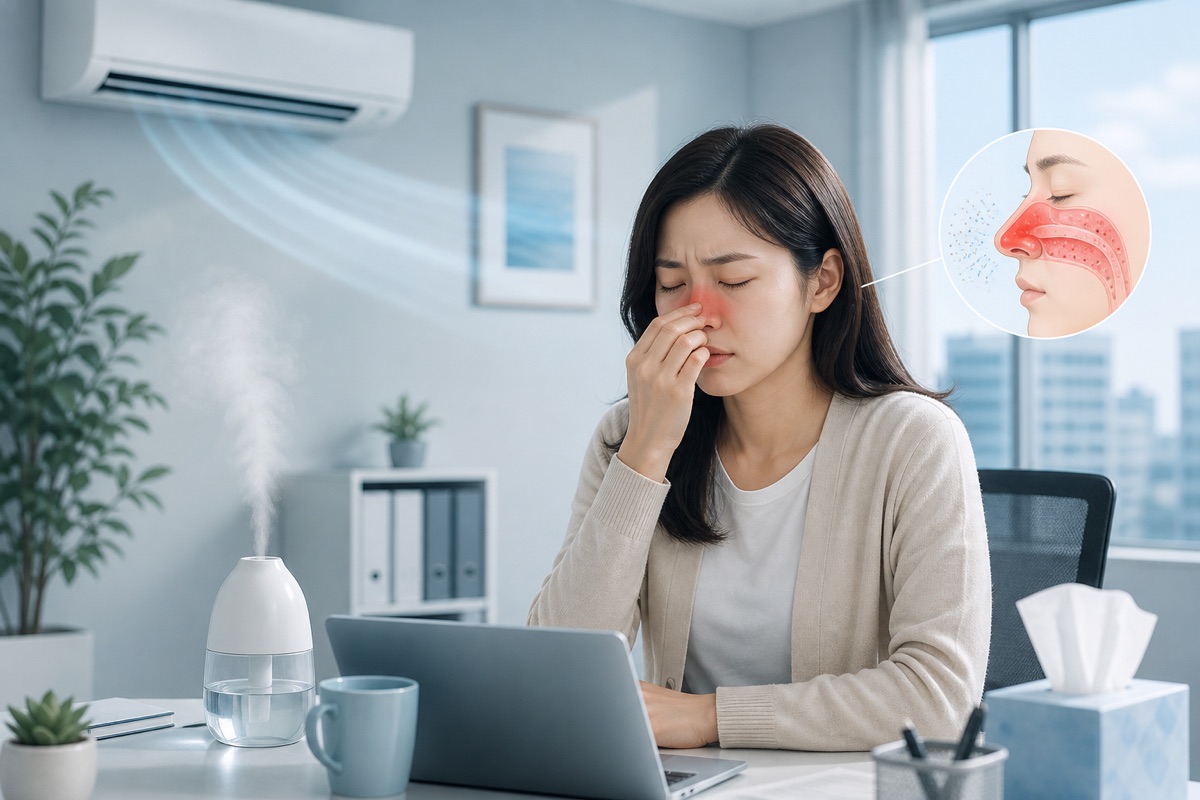
Many people who complain of stuffy nose in the middle of summer are not reacting to a cold but to the air-conditioning environment. Cold air stimulates the autonomic nerves of the nasal mucosa and causes it to swell, indoor humidity lowered by air conditioning dries out the mucous membrane, and mold and dust accumulated on the filter and cooling fins add to the irritation of allergies.
The terms ‘air-conditioning sickness’ and ‘air-conditioning rhinitis’ are often used interchangeably, but their mechanisms differ, although they can overlap. Below, we outline how to differentiate and practical changes you can make.
Summary
- Temperature-stimulated type: clogged immediately in front of cold wind, loosens in a warm place
- Dry type: Nose and throat are dry in the morning, and snot and nosebleeds increase.
- Allergen type: Sneezing and itchy eyes only occur in certain areas (office, car)
- A reasonable baseline is within 5 to 6 degrees of indoor/outdoor temperature difference and 40 to 50% humidity.
- The key is to clean the filter every two weeks during the cooling season and clean the cooling fins before the season starts.
1. How air-conditioning syndrome differs from air-conditioning-related rhinitis
‘Air-conditioning syndrome’ is not an official name for the disease, but rather a term that refers to a group of symptoms that occur in an air-conditioned environment. Headache, fatigue, muscle pain, indigestion, and nasal symptoms appear together. On the other hand, air-conditioning-related rhinitis is mainly characterized by symptoms limited to the nose.
| Category | Air-conditioning syndrome | Air-conditioning-related rhinitis |
|---|---|---|
| Main symptom | General fatigue, headache, muscle pain, gastrointestinal symptoms | Nasal congestion, clear runny nose, sneezing |
| Trigger | Large indoor/outdoor temperature difference, long-term exposure to low temperatures | Cold air irritants, dryness, indoor allergens |
| Recovery | If you change the environment, improvement usually occurs within a day. | Persists with repeated exposure |
| Conditions to rule out | Summer cold, dehydration | Allergic rhinitis, vasomotor rhinitis |
In rare cases, there are separate problems associated with fever, such as Legionella infections associated with cooling towers or contaminated water facilities. If a high fever, cough, and difficulty in breathing come together, it should not be dismissed as air-conditioning syndrome.
2. Three mechanisms
2-1. Temperature irritation — a non-allergic reaction
The blood vessels of the nasal mucosa are innervated by the autonomic nervous system and respond immediately to temperature changes. If going from 28 degrees outside to 22 degrees in the office is repeated several times a day, the mucous membranes swell and secretion increases. Allergy tests often come back negative, and this condition is classified as vasomotor rhinitis.
The clues checked at the clinic are simple. It will become clogged within a few minutes at a location directly exposed to cold wind, and improves after moving away from the airflow.
2-2. Dryness — cilia slow down
The nasal mucosa uses mucus and cilia to push foreign substances out. This function decreases at low humidity. In an air-conditioned room, the humidity often falls below 30%, which makes the mucus sticky and delays its excretion. This includes dryness and crusting inside the nose in the morning, or a little blood when blowing the nose.
2-3. Indoor allergens — air conditioners can harbor mold and dust
Condensation forms on the cooling fins, and when that moisture and dust meet, mold grows. An air conditioner that emits a characteristic odor immediately after starting operation may be in this condition. High humidity in summer is also an advantageous condition for dust mites, so the indoor allergen burden can be greater in summer than in winter.
The key to distinguishing is location. If you start sneezing and itchy eyes only in a specific office or car, suspect allergens rather than temperature.
3. Practical changes you can make
3-1. Environmental settings
- Temperature difference between indoor and outdoor is within 5 to 6 degrees: If it is 33 degrees outside, a realistic goal is around 27 degrees. If you lower it too much, temperature irritation symptoms will become worse.
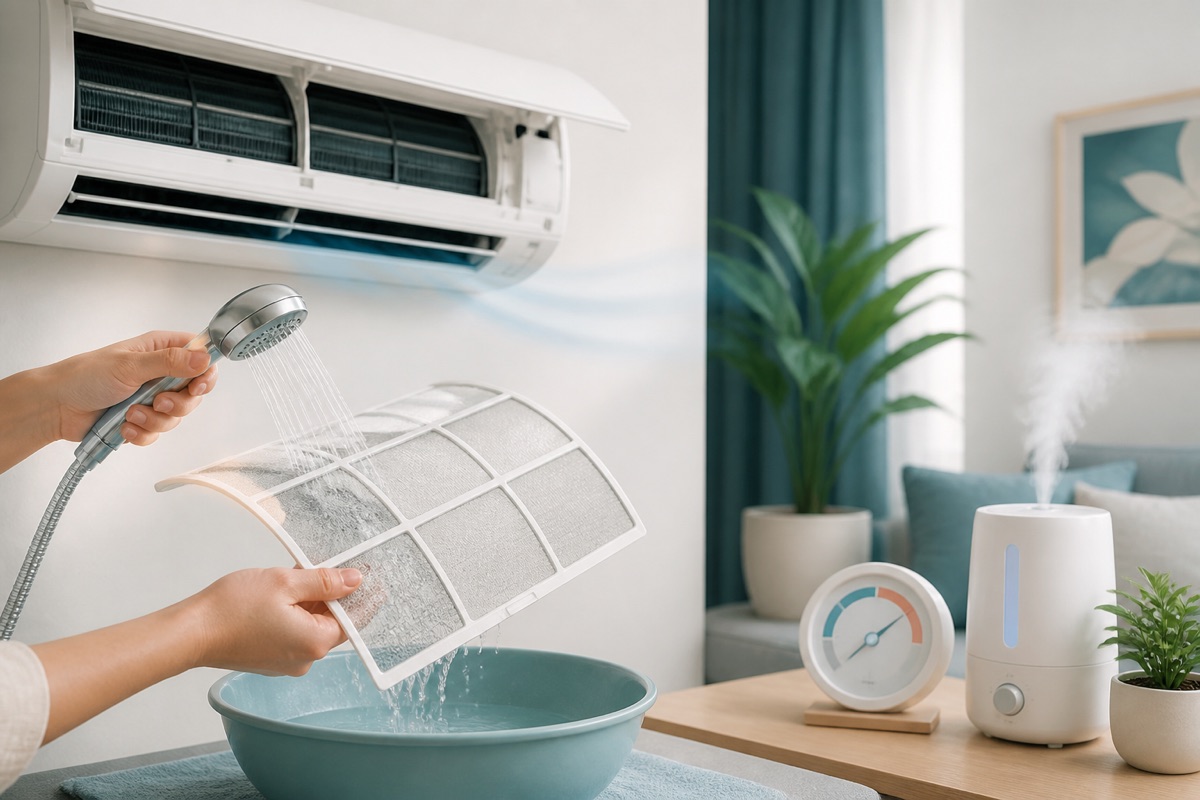
- Maintain humidity at 40-50%: The experience varies depending on whether you use a humidifier or place a wet towel while cooling. Above 60%, mold and dust mites become a greater concern.
- Avoid direct exposure to air vents: Many people find that their nasal symptoms are reduced just by turning the wind direction upward.
- Ventilate every 2-3 hours: In closed air-conditioned spaces, carbon dioxide and airborne allergens accumulate together.
3-2. Air-conditioner maintenance
| Part | Cycle | Method |
|---|---|---|
| Filter | 2 Weeks during cooling season | After disassembly, wash with lukewarm water and dry completely before installation. |
| Cooling fins (heat exchanger) | Once before the season starts | Dedicated cleaner or professional cleaning |
| Drain hose | Before the season starts | Check for blockages and backflow |
| After operation ends | Every day | Internal drying in blower mode for 10 to 20 minutes |
The last item is most often missing. If you blow dry the inside before turning it off, the conditions for mold growth will be reduced.
3-3. Nose care
Saline nasal irrigation washes away dried mucus and adsorbed dust. Since it is not a drug, it is less burdensome to use once or twice a day. However, rather than using tap water as is, you should use sterilized water or saline solution made from boiled and cooled water.
Commercial vasoconstrictor sprays provide immediate relief, but are difficult to use every day throughout the summer. Product instructions and doctor/pharmacist instructions take precedence, and generally do not exceed 3 consecutive days. If you use it for a long time, the effectiveness of the drug may decrease and it may lead to drug-induced rhinitis, which is more clogged than before use. This condition is difficult to distinguish because the symptoms overlap with air-conditioning-related rhinitis.
4. Signs you shouldn’t ignore
- Fever over 38 degrees Celsius lasting more than two days
- Yellowish runny nose and facial pain that lasts for more than 10 days or gets better and then gets worse again
- Consistently blocked nose on one side
- Continues to be unable to smell at all
- When coughing and feeling short of breath occur together
Frequently Asked Questions
Q. When I turn on the air conditioner, my nose gets stuffy right away. Is this an allergy? A. If it reacts within a few minutes and resolves when moved to a warm place, it is most likely vasomotor rhinitis caused by temperature stimulation. Allergy tests often come back negative, and alleviating temperature differences and adjusting the airflow direction are more helpful than antihistamines.
Q. Will the smell and symptoms go away if I just change the air conditioner filter? A. The filter only catches surface dust, and the cause of the odor is usually mold on the inner cooling fins. If an initial odor remains even after replacing the filter, internal cleaning is considered necessary.
Q. Do I need to use a humidifier even in summer? A. Yes, if it is a space that is cooled for a long time. Because air conditioners remove moisture from the air, indoor humidity becomes lower than expected. However, it is recommended to keep a hygrometer and adjust it so that it does not exceed 50%.
This article is general health information and is not a substitute for individual medical care. If symptoms persist or worsen, please seek treatment at a medical institution.