There are two things to do when you have a nosebleed: Bend your head slightly forward, grab the soft nostrils, not the bridge of your nose, with your fingers, and press without letting go for more than 10 minutes. “Throwing your head back” and “tapping the nape of your neck” learned as a child are not effective in hemostasis and can cause blood to flow into the throat, causing nausea or aspiration.
About 90% of nosebleeds occur in the Kiesselbach area in front of the nasal septum. This area contains a dense network of superficial vessels, which is why direct finger pressure can reach the usual bleeding site.

Summary
- Posture: Sit with head slightly forward (do not tilt)
- Compression: Hold both nostrils with your thumb and index finger for 10 to 15 minutes continuously (do not let go to check in between)
- Avoid: tilting your head back, shoving a tissue deep in, blowing your nose vigorously.
- Avoid blowing your nose, exercising vigorously, or taking hot baths for 24 hours after stopping.
- If it does not stop for more than 20 minutes, recurs, or continues on one side, you need medical attention.
1. Where do nosebleeds come from?
| Category | Anterior bleeding | Posterior bleeding |
|---|---|---|
| Proportion | Most cases | Minority |
| Location | In front of the nasal septum (Kiesselbach area) | Large blood vessels behind the nasal cavity |
| Aspect | Flowing out of the nostrils | Strong feeling of it going down the back of the throat |
| Self hemostasis | Usually possible with pressure | Difficulty, requires medical attention |
| Typical age group | Pediatrics, young adults | Older adults; people with hypertension or vascular disease |
If coming from the front, finger pressure acts directly on the bleeding point. Conversely, if blood continues to go down the back of the throat and not much comes out of the nostrils, you should suspect posterior bleeding and go to a medical institution without delay.
2. Why nosebleeds recur
2-1. Dryness and damage to mucous membranes
The most common combination is dry air and the habit of touching your nose. Heating in winter and cooling in summer both reduce indoor humidity. When the mucous membrane dries, a thin scab forms, and when the scab falls off, the underlying blood vessels are exposed. In many cases of repeated nosebleeds in children, the habit of picking one’s nose overlaps with this.
2-2. Rhinitis and sinus inflammation
Inflammation causes mucosal blood vessels to dilate and become vulnerable. When patients with allergic rhinitis frequently rub their nose and blow their nose vigorously, it also causes physical irritation.
2-3. Medications
Anticoagulants, antiplatelet drugs (including aspirin), and some painkillers and anti-inflammatory drugs increase the tendency to bleed. Even with steroid nasal sprays, if the direction of spray is directed toward the nasal septum, the mucous membrane in that area may become damaged. It is better to hold the spray with the opposite hand and spray it in an outward direction, toward the corners of the eyes.
2-4. Systemic factors
There is controversy as to whether high blood pressure itself is the direct cause of nosebleeds, but it is a factor that makes it difficult to stop bleeding that has already started. In addition, there may be underlying diseases such as blood coagulation abnormalities, liver disease, and hereditary hemorrhagic telangiectasia.
2-5. Structural causes
If the nasal septum is severely deviated, air strongly hits the protruding mucosa, causing local dryness and repeated bleeding in the same area. If you hear something like “it always comes from the same side,” check this possibility first.
3. Step-by-step hemostasis method
3-1. What to do on the spot
- Sit down. Keeping your head above heart level lowers the blood pressure inside your nose. Don’t lie down.
- Bow your head slightly forward. This is to prevent blood from going down the throat. Breathe through your mouth, and spit out any blood that accumulates in your mouth rather than swallowing it.
- Pinch the soft part of your nose. Completely compress both nostrils below the hard nasal bones with your thumb and index finger.
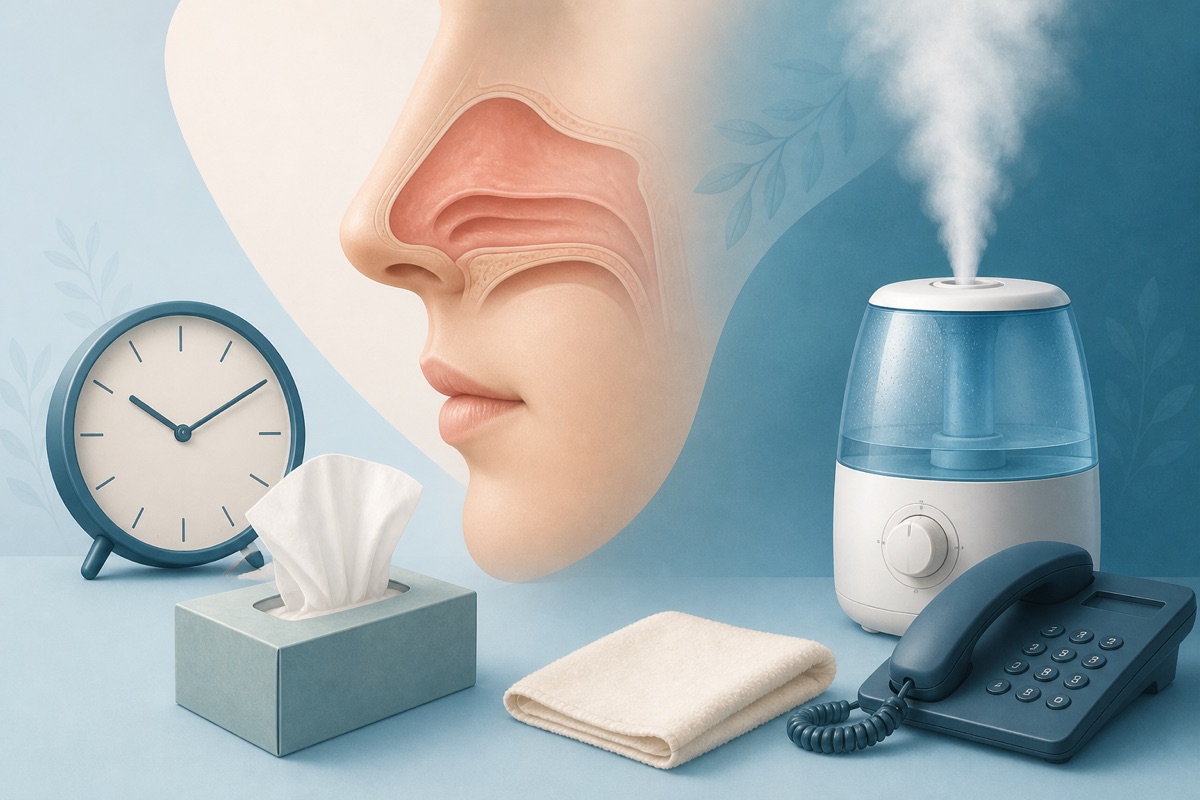
- Do not let go for 10 to 15 minutes. If you remove your hand to check if it has stopped properly, the forming clot may be dislodged. Look at the clock and count.
- A cold pack may be added. Applying it to the bridge of your nose or cheeks helps constrict blood vessels. It is no substitute for pressure.
3-2. What not to do
| Wrong way | Problem |
|---|---|
| Tilt your head back | Risk of nausea, vomiting, and aspiration due to blood flowing into the pharynx |
| Tapping the nape of the neck | Not related to hemostasis |
| Push toilet paper/cotton deeply | When removed, the clot falls off and rebleeds. |
| Blowing your nose hard | Blows away blood clots that have formed |
| Lie down | Increased intranasal venous pressure |
3-3. The first 24 hours after bleeding stops
Avoid blowing your nose, strenuous exercise, and hot baths or saunas. To prevent the inside of your nose from drying out, you can reduce the cracking of scabs by using saline spray or applying a thin layer of Vaseline to the entrance to the nostrils with a cotton swab.
4. If you need immediate medical attention
- Does not stop for more than 20 minutes even with pressure
- Heavy bleeding or dizziness, paleness, and cold sweat
- Blood mainly flows down the back of the throat (posterior bleeding suspected)
- Occurs after facial trauma
- Taking anticoagulant/antiplatelet medication
- Recurring on the same side, or nasal congestion or facial paresthesia on one side along with nosebleeds
- In children with frequent nosebleeds, bleeding gums or easy bruising
The last two items are not explained by simple dry nosebleeds. If the repeated area is constant, it is more reliable to check the bleeding point with an endoscope and control it with local cauterization than to endure it with pressure every time. Hematological evaluation may be necessary if a child also has a tendency to bleed.
Frequently Asked Questions
Q. Is it okay if my child gets a nosebleed while sleeping? A. It often occurs when you rub your nose while sleeping in a dry room or when mucous membrane scabs fall off. The frequency is often reduced by setting the humidity to 40-50% and keeping the nostril openings moist. However, if the amount is large or repeats more than twice a week, please check.
Q. Can I stick a tissue in my nose when I have a nosebleed? A. When in a hurry, it is okay to slightly block the nostril entrance for absorption, but pushing it in deeply is not recommended. When removed, the clotted portion often falls off and bleeds again. Finger pressure is more reliable.
Q. Do nosebleeds occur more often if I have high blood pressure? A. There is no clear evidence that high blood pressure directly causes nosebleeds. However, if blood pressure is high, it may take longer for bleeding to stop and the amount of bleeding may increase. If nosebleeds recur, it is helpful to manage your blood pressure and check the medications you are taking.
This article is general health information and is not a substitute for individual medical care. If symptoms persist or worsen, please seek treatment at a medical institution.