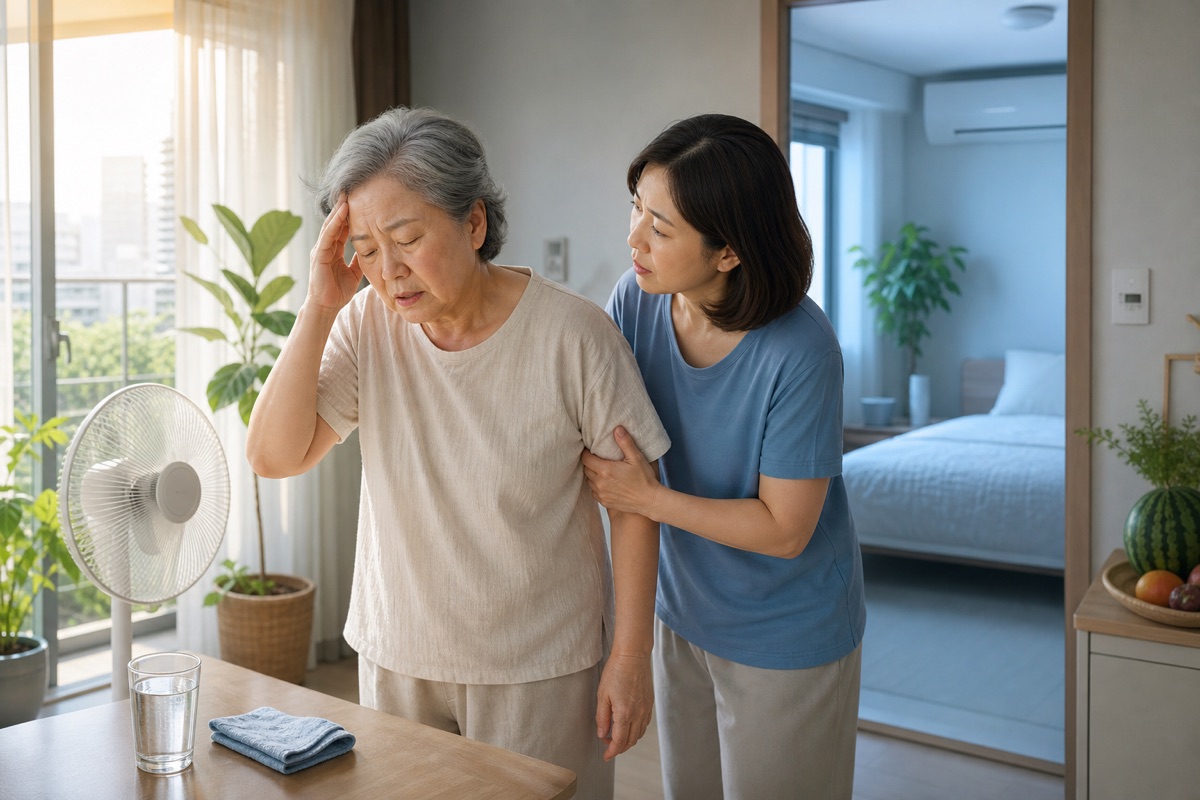
The reason heat illness is dangerous for older adults is because symptoms appear late. The sense of thirst is dulled and sweat secretion is reduced, so there are many cases where dehydration and increased body temperature have already occurred while the person says, “I’m fine.”
Therefore, for heat-related illnesses in older adults, it is necessary to rely on the caregiver’s observation rather than the patient’s own complaints. Below is a summary of what to look for, what time of day to manage, and when to call 119.
Summary
- Older adults have a slower thirst and sweating response, so symptoms are recognized later. Observation is more important than words
- Unusual lethargy, decreased speech, and confusion may be early signs of heat-related illness.
- Your risk increases if you are taking diuretics, anticholinergics, or antipsychotics.
- Avoid going out between 12pm and 5pm, and drink water at set times regardless of thirst.
- If you see a change in consciousness, consider it heatstroke and call 119 immediately.
1. Why are older adults more at risk?
1-1. The body’s signals come late
As you age, your thirst threshold increases. Even if the body lacks water, thirst does not occur easily, so intake decreases, and the kidneys’ ability to retain water also decreases, leading to continued loss. The sweat glands also become less responsive, so they dissipate less heat than younger people at the same temperature.
The water content in the body itself is also low. This means that the same amount of loss creates a greater change than for younger people.
1-2. Drugs increase risk
| Medication | Action | Problems in heat waves |
|---|---|---|
| Diuretics (hypertension, heart failure) | Increased urine output | Accelerated dehydration |
| Anticholinergics (overactive bladder, some stomach medications) | Secretion inhibition | Decreased heat dissipation due to reduced sweat secretion |
| Beta-blockers | Heart rate and skin blood flow control | Slowing down heat dissipation reaction |
| Antipsychotics and some antidepressants | Central influence on thermoregulation | Increased risk of high temperature |
| Combination medications containing a diuretic | — | In some cases, you may not know that you are taking it. |
It is more dangerous to randomly stop taking medications. During heat waves, it is better to discuss with your doctor in advance whether you need to adjust your fluid intake or medication schedule.
1-3. Environmental factors
Even if you have an air conditioner, you do not turn it on due to the high electricity bill, if you have a structure with only one window and no ventilation, or if you live in a residential structure such as a rooftop or semi-basement, heat-related illnesses can occur even indoors. This is why indoor outbreaks account for a significant portion of domestic heat-related disease statistics.
2. Signals for caregivers to check
2-1. Changes in speech and behavior
The first warning sign may be a change in behavior rather than body temperature. If you talk less than usual, answer a beat later, or repeatedly stop an activity and sit down, you should distinguish this from just being hot. If you are confused about time or place or exhibit unusual behavior that is different from usual, consider it a change in consciousness and immediately call 119.
2-2. Physical signs to check
- Armpits are dry and skin is hot
- Urine frequency decreases and the color becomes darker.
- If you pull the skin on the back of your hand and release it, it will come back slowly.
- Lips and tongue are dry
- Your heart rate is faster than usual
2-3. Check twice a day
It is realistic to check by phone or visit at set times in the morning and evening. Three items to check are sufficient. How many glasses of water did you drink today, did you urinate, and what is the temperature in the room?
3. Daily management
3-1. Time of day
| Time | What to do |
|---|---|
| 6-9 AM | Go out, take a walk, or go grocery shopping within this time. |
| 12:00 – 5:00 PM | No outdoor activities. relax indoors |
| After 5pm | Activities resume after temperatures drop |
| Night | Even on tropical nights, do not turn cooling off completely. Maintain at a setting of 26 to 28 degrees |
3-2. Hydration
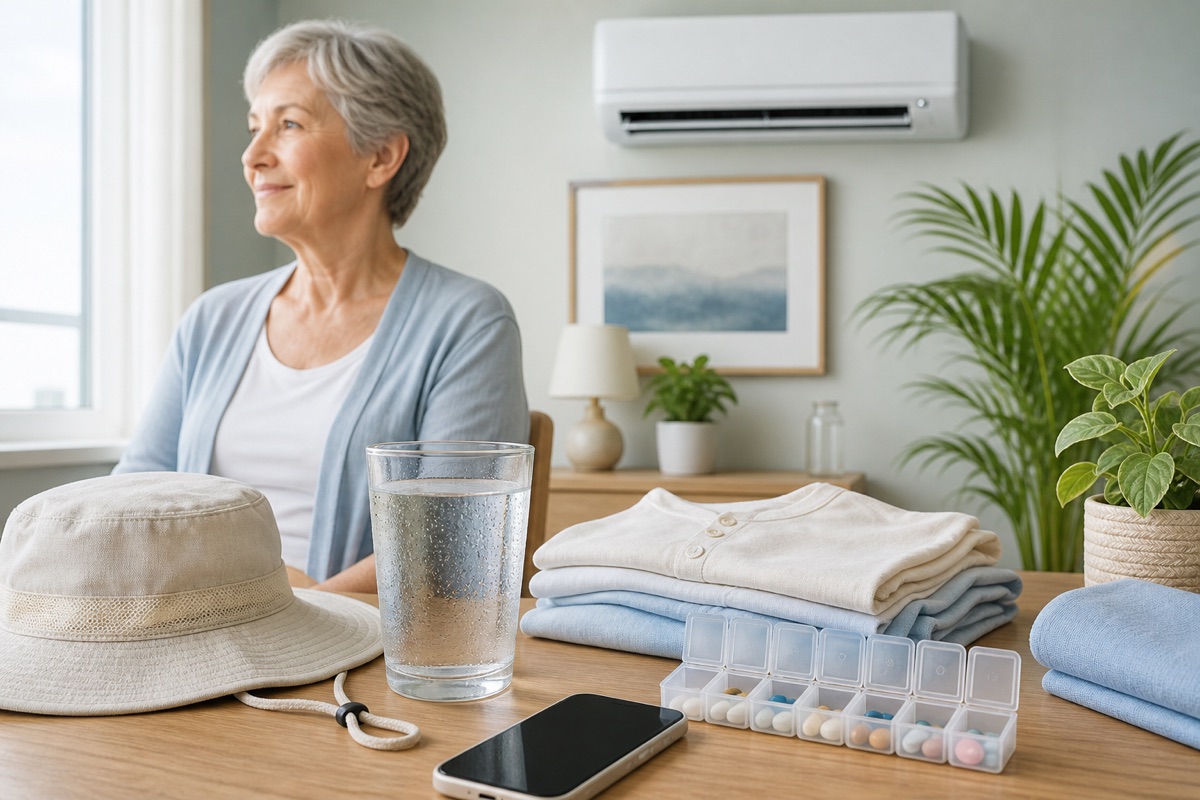
The key is to allow yourself to drink on time rather than relying on thirst. It is better for both absorption and burden to drink about 200mL at a time, divided into intervals of one to two hours. It is also practical to keep a water bottle visible and measure your intake by the remaining amount.
However, there is an exception for those who are restricted from fluids due to heart failure or chronic kidney disease. In this case, the daily allowance is limited, so you should use your doctor’s instructions as a guideline.
3-3. Cooling and ventilation
If you don’t have air conditioning, using only a fan is limited. When the indoor temperature exceeds 35 degrees, the fan wind only circulates hot air, so it is safer to move to air-conditioned public places such as heat shelters, community centers, and libraries during the day.
4. When to call 119
Call 119 without delay if any of the following applies.
- Blurred consciousness or inability to communicate
- Slow to respond or talking nonsense when your name is called
- Convulsions
- Skin is hot but no sweat
- Unable to drink water due to repeated vomiting
- Move to a cool place and do not recover even after 30 minutes
After calling 119, move the person to a cool place, loosen your clothes, and apply a cold towel to your neck, armpits, and groin to get some air. If the patient is not conscious, do not give them water or drinks and lay them on their side to ensure an airway.
5. Summer-related problems frequently seen in clinics
Among the nose and throat symptoms complained of by older adults during heat waves, dehydration and air-conditioning dryness often overlap. When the mucous membrane dries, nosebleeds become more frequent, a feeling like something is stuck in the throat, or a dry cough occurs. When complaining of dizziness, it is necessary to distinguish between vestibular problems and orthostatic dizziness caused by dehydration, and the proportion of the latter increases in summer. That is why it is meaningful to first check the heat and water intake when an older adult says they are “dizzy.”
Frequently Asked Questions
Q. My older family member dislikes direct air-conditioning airflow. What should I do? A. An alternative is to set it to 26-28 degrees and turn the direction upward to prevent the wind from hitting the body directly, or to cool another room and leave the door open. It is safer to lower the indoor temperature than to turn off the air conditioning altogether.
Q. I don’t drink water often. Is there a way to replace it? A. You can replace some of it with foods that are high in water. Cucumber, watermelon, seaweed soup, or clear soups are common choices. However, if you have kidney disease, you may be restricted from eating fruits high in potassium, so you need to check.
Q. What if you said you would continue working in the fields or maintaining the garden? A. If it is difficult to completely prevent it, negotiating to move the time zone is realistic. Limit outdoor work to no more than one hour before 9 a.m., and be sure to bring a wide-brimmed hat and a water bottle. If you make it a rule not to go out alone and to contact others before going out, you can reduce situations where accident detection is delayed.
This article is general health information and is not a substitute for individual medical care. If symptoms persist or worsen, please seek treatment at a medical institution.